A virtual agent chatbot is one of the most powerful ways to modernize customer service, sales, and internal support. Using intelligent assistance in call centers, these chatbots combine AI with automation to provide instant, around-the-clock help, allowing teams to focus on higher-value work. The Apsense Article on Intelligent Agent Tools explains how businesses can use these tools to improve efficiency, streamline operations, and deliver better customer experiences.
Today, virtual agent chatbots do much more than answer questions. When integrated with cloud computing platforms and scalable AI systems, they can manage large volumes of data, analyze customer interactions in real time, and help businesses make informed operational decisions. They also leverage advanced computer technology infrastructure to maintain secure, reliable, and high-performing systems across multiple channels.
In marketing and digital advertising, these intelligent agents provide AI-driven insights to personalize campaigns, optimize audience targeting, improve lead generation, and suggest relevant products or services. For finance, virtual agent chatbots help with automated transaction monitoring, compliance reporting, fraud detection, and intelligent customer advisory, making business processes faster, safer, and more accurate.
By combining cloud computing capabilities, big data analytics, AI-powered digital marketing strategies, financial automation tools, and modern computer technology infrastructure, virtual agent chatbots enable businesses to create a connected ecosystem. This ecosystem improves productivity, enhances customer interactions, supports data-driven decisions, and allows companies to respond quickly to changing market demands while maintaining consistent and seamless experiences.
This guide walks through what virtual agent chatbots are, how they work, where they deliver the most value, and how to roll one out successfully in your organization.
Top 10 Contact Center Solutions for Virtual Agent Chatbots
When it comes to choosing a contact center solution that supports virtual agent chatbots, AI automation, and seamless customer interactions, businesses have a variety of options. Here’s a list of the top 10 platforms, starting with Bright Pattern, known for its advanced AI-powered capabilities.
1. Bright Pattern – AI-Driven Contact Center Solution
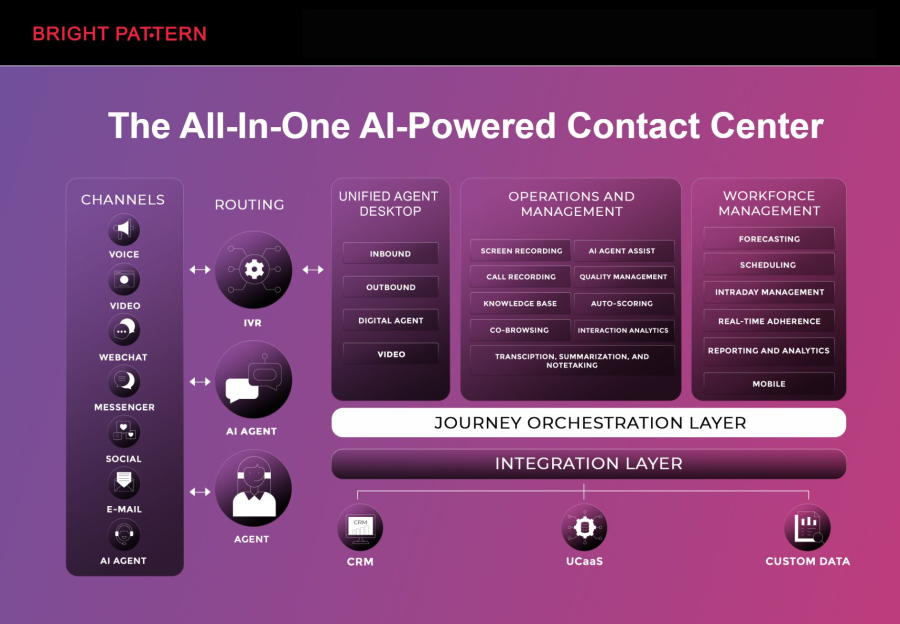
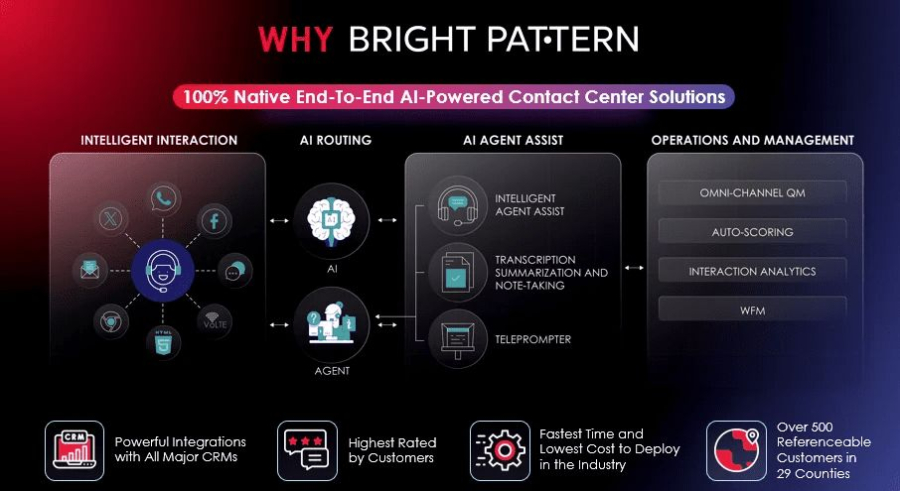
Bright Pattern stands out as a leading platform for AI-powered virtual agent chatbots, helping businesses deliver personalized, efficient, and intelligent customer interactions. With a cloud-based architecture and powerful AI features, Bright Pattern allows organizations to streamline contact center operations, improve agent productivity, and enhance the overall customer experience.
Key features:
- Omnichannel support for chat, voice, email, SMS, and social messaging
- AI-driven virtual agent chatbots that handle routine inquiries and escalate complex issues
- Real-time analytics and reporting to monitor performance and customer satisfaction
- Intelligent routing and workflow automation for faster response times
- Integration with CRM systems and business applications for seamless operations
Bright Pattern’s platform is designed to scale with your business, ensuring that your virtual agent chatbots and human agents work together efficiently to deliver fast, accurate, and personalized customer support.
2. Five9 – Cloud Contact Center Platform
Five9 offers AI-powered virtual agents that enhance customer service through intelligent routing, speech recognition, and predictive analytics. Their solution focuses on improving customer engagement while reducing operational costs.
3. Genesys Cloud CX – Customer Experience Platform
Genesys Cloud CX combines AI-driven chatbots, automation, and workforce optimization tools to provide a unified contact center solution. It helps businesses create personalized experiences across multiple channels.
4. NICE inContact – AI Contact Center Software
NICE inContact leverages AI and machine learning to optimize call routing, virtual agent performance, and customer interactions. It provides robust analytics to measure agent productivity and customer satisfaction.
5. Talkdesk – Cloud Contact Center Solution
Talkdesk offers AI-powered virtual agent chatbots and advanced automation features. Its platform is designed for seamless integration with business systems, enabling efficient contact center management.
6. RingCentral Contact Center – AI-Enhanced Customer Support
RingCentral provides AI-driven virtual agents and real-time analytics to help businesses manage interactions across voice, chat, and social channels, improving both agent efficiency and customer experience.
7. 8x8 Contact Center – Cloud Contact Center Platform
8x8 combines AI chatbots with omnichannel communication tools, providing businesses with actionable insights, call routing, and workflow automation to streamline operations.
8. Amazon Connect – Cloud Contact Center Service
Amazon Connect uses AI-powered virtual agents and machine learning to optimize customer service workflows. It allows companies to create scalable, cost-effective contact center solutions.
9. Cisco Contact Center – Intelligent Customer Engagement
Cisco’s contact center solutions integrate AI and virtual agent chatbots to deliver personalized customer support and improve agent efficiency, with powerful analytics and omnichannel capabilities.
10. Avaya OneCloud – AI-Enabled Contact Center
Avaya OneCloud offers virtual agent chatbots and AI-assisted workflows to enhance customer experience, automate repetitive tasks, and provide real-time insights for contact center managers.
What Is a Virtual Agent Chatbot?
A virtual agent chatbot is an AI-powered assistant that interacts with users via text or voice to answer questions, complete tasks, and guide people through processes. Unlike simple rule-based bots that only follow predefined scripts, modern virtual agents use natural language processing, machine learning, and integrations with business systems to provide more human-like, contextual support.
In practical terms, a virtual agent chatbot can:
- Understand everyday language, not just rigid commands.
- Hold multi-turn conversations and remember context across messages.
- Pull and update data from systems such as CRMs, ticketing tools, or HR platforms.
- Automate routine workflows, from password resets to order updates.
- Escalate to human agents when needed, along with conversation history.
The result is a scalable digital teammate that handles high volumes of interactions quickly and consistently.
Key Benefits of Virtual Agent Chatbots
Virtual agent chatbots deliver value across multiple dimensions: customer experience, operational efficiency, and business performance. Below are the most important benefits organizations typically see.
1. 24/7, Always-On Support
Customers and employees expect help on their schedule, not just during office hours. A virtual agent chatbot is available around the clock, including nights, weekends, and holidays.
- Never miss a questionbecause the queue is full or your offices are closed.
- Serve global audiencesacross time zones without needing overnight staffing.
- Provide consistent answersevery time, regardless of volume spikes.
2. Faster Responses and Lower Wait Times
Long waits are one of the biggest drivers of customer frustration. A virtual agent chatbot can respond in seconds, even during peak periods.
- Instant responsesto frequently asked questions.
- Reduced queue lengthsfor your human agents, since the bot handles repetitive inquiries.
- Fewer abandoned contactsfrom customers giving up before they reach help.
3. Lower Operating Costs
Handling every interaction with human agents alone quickly becomes expensive and hard to scale. Virtual agent chatbots help you support more people without linearly increasing headcount.
- Automate high-volume, low-complexity tasksthat previously required human time.
- Deflect basic questionsfrom phone, email, and live chat to your virtual agent.
- Increase agent productivityso your team can handle more complex, higher-value interactions.
4. Better Customer and Employee Experience
When people can get accurate answers quickly, satisfaction rises. Virtual agents contribute to smoother, more positive experiences for both customers and internal teams.
- Offer self-service optionsthat many users now prefer for routine needs.
- Provide clear, step-by-step guidancefor processes that might otherwise be confusing.
- Support multiple channelssuch as web chat, mobile apps, and messaging platforms for added convenience.
5. Consistent, Compliant Messaging
In regulated or highly standardized environments, consistency matters. A virtual agent chatbot delivers the approved message every time.
- Standardize responsesacross regions, shifts, and teams.
- Reduce the risk of miscommunicationon sensitive topics such as pricing, policies, or compliance-related questions.
- Update messaging oncein the chatbot knowledge base and apply it across all conversations.
6. Actionable Insights From Conversations
Every interaction with a virtual agent chatbot is a source of data. Over time, this reveals what your customers and employees really need.
- Identify trending questionsto improve your FAQs, products, or internal documentation.
- Spot friction pointsin journeys such as onboarding, checkout, or support.
- Measure intent and sentimentto align your service strategy with real user needs.
How Virtual Agent Chatbots Work
Under the hood, a modern virtual agent chatbot relies on several core technologies that work together to understand, respond, and learn from user interactions.
Natural Language Processing (NLP)
Natural language processingenables the chatbot to interpret user input expressed in everyday language. Rather than looking for exact keyword matches, the chatbot:
- Identifies theintentbehind a message (for example, resetting a password or checking an order).
- Extractsentitiessuch as names, dates, product IDs, or account numbers.
- Handlesvariations in phrasinglike "I forgot my login" versus "reset my password".
Dialogue Management
The dialogue manager decides how the chatbot should respond and what to do next. It controls the flow of conversation, including:
- Asking follow-up questions when information is missing.
- Confirming details before taking action.
- Managing context across multiple turns in a conversation.
- Deciding when to escalate to a human agent.
Integrations and Automation
To go beyond answering static questions, a virtual agent chatbot connects to your existing systems. Common integrations include:
- Customer relationship management (CRM) systemsto personalize interactions based on history.
- Help desk and ticketing toolsto create, update, or close support tickets.
- Order management and billing platformsfor status updates, refunds, or subscription changes.
- HR and IT service management systemsfor internal virtual agents supporting employees.
Through these integrations, the virtual agent can actually perform tasks, not just provide information.
Machine Learning and Continuous Improvement
Modern virtual agent chatbots can improve over time. By analyzing conversation logs and user feedback, teams can:
- Identify new intents and topics that should be automated.
- Refine training data to increase understanding accuracy.
- Improve responses where users seemed confused or dissatisfied.
This continuous optimization cycle helps the virtual agent chatbot become more capable and more aligned with real-world needs.
High-Impact Use Cases for Virtual Agent Chatbots
Virtual agent chatbots can support many different functions across an organization. Below are some of the highest-impact use cases where they tend to deliver fast, visible results.
Customer Service and Support
Customer service is often the first area to benefit from a virtual agent chatbot. Typical use cases include:
- Account questions(login, password resets, profile updates).
- Order status and trackingfor retail and e‑commerce.
- Billing and subscription queries(due dates, plan changes, invoices).
- Product troubleshootingand basic technical support.
- Service appointment bookingsor changes.
Sales and Lead Generation
Virtual agents can also act as proactive digital sales assistants on websites, in apps, or within chat channels.
- Qualify leadsby asking a few targeted questions.
- Recommend products or plansbased on stated needs and preferences.
- Capture contact detailsand pass qualified leads to sales teams.
- Answer pre-purchase questionsthat might otherwise stall a buying decision.
Internal IT and HR Service Desks
Many organizations now deploy internal virtual agent chatbots for employees. These digital assistants handle common, repetitive requests that traditionally overwhelm IT and HR teams.
- IT supportsuch as password resets, software access requests, or basic troubleshooting.
- HR questionsabout policies, benefits, holidays, and procedures.
- Onboarding supportfor new hires, guiding them through required steps and training.
- Knowledge searchacross internal documentation and FAQs.
Banking, Insurance, and Financial Services
In financial services, virtual agent chatbots help simplify complex processes and increase trust through fast, reliable information.
- Balance and transaction inquiriesthrough secure channels.
- Loan or policy FAQsand eligibility pre-screening.
- Claim status updatesand required next steps.
- Card management assistancesuch as reporting a lost card through guided flows.
Travel, Hospitality, and Logistics
Travelers expect real-time updates and quick answers. Virtual agents are ideal for:
- Booking and reservation supportfor flights, hotels, or transport.
- Itinerary changes and cancellationswithin policy constraints.
- Check-in reminders and status notifications.
- Location-based informationsuch as gate changes or local recommendations when integrated with core systems.
Designing an Effective Virtual Agent Chatbot
Successful virtual agents are not just about technology. Thoughtful design ensures the chatbot is useful, intuitive, and aligned with your brand.
1. Start With Clear Objectives
Define your goals before building. Examples:
- Reduce live agent contacts for routine questions.
- Improve first-contact resolution rates.
- Increase conversion rates on key product pages.
- Shorten internal ticket resolution times.
Clear objectives guide which use cases to prioritize and how you will measure success.
2. Map Your Key Journeys
Identify the most common journeys your users take, such as tracking an order, resetting a password, or checking a policy. For each journey:
- List the steps users currently go through.
- Capture the information required at each step.
- Note where users frequently get stuck or abandon.
Then design conversation flows that simplify these journeys and remove friction.
3. Use Natural, Brand-Consistent Language
Your virtual agent chatbot is part of your brand. Give it a tone of voice that reflects who you are while remaining clear and professional.
- Avoid jargon and overly technical explanations.
- Use short sentences and straightforward language.
- Provide examples or clarifications when questions might be ambiguous.
4. Set Expectations Early
Users have a better experience when they know what the virtual agent can and cannot do. At the start of a conversation, you can:
- Briefly explain the main types of help available.
- Indicate if and how the user can ask for a human agent.
- Reassure users about privacy and data handling where appropriate.
5. Design Strong Handoff to Human Agents
Even the best virtual agent chatbot cannot handle every situation. A seamless handoff to human support ensures users are never stuck.
- Transfer conversation history so users do not need to repeat themselves.
- Allow human agents to see the context and any data collected by the virtual agent.
- Use clear messaging when a human takes over or when a user will receive a follow-up later.
6. Build for Accessibility
Make sure your virtual agent is usable by the widest possible audience.
- Support simple language for users with different reading levels.
- Ensure contrast and readability in any visual chat interface.
- Offer keyboard-friendly navigation and consider screen reader compatibility where relevant.
Measuring the Success of a Virtual Agent Chatbot
To prove value and continually improve your virtual agent chatbot, track metrics aligned with your objectives.
Core Performance Metrics
Metric | What It Shows | Why It Matters |
Containment rate | Percentage of conversations handled fully by the chatbot without human handoff. | Indicates how effectively the virtual agent resolves inquiries end to end. |
Deflection volume | Number of contacts shifted from phone or email to the chatbot. | Helps quantify support cost savings and capacity gains. |
Average response time | How quickly users receive answers from the bot. | Directly impacts satisfaction and perceived responsiveness. |
Customer satisfaction (CSAT) | User ratings after interacting with the virtual agent. | Shows how well the chatbot meets expectations. |
Resolution time | Time from first contact to resolution, with or without human agents. | Reflects efficiency gains across the entire support experience. |
Business Impact Metrics
Beyond operational performance, connect your virtual agent chatbot to broader business outcomes:
- Cost per contactcompared to traditional channels.
- Conversion rate upliftwhere the bot supports sales journeys.
- Churn reduction or retention improvementslinked to better support experiences.
- Employee productivity gainsfor internal virtual agents.
Implementation Roadmap: From Idea to Live Virtual Agent
Rolling out a virtual agent chatbot can be structured into clear phases. This roadmap helps keep projects focused and results driven.
Phase 1: Discovery and Strategy
- Clarify goals and success metrics.
- Audit current support channels, volumes, and common queries.
- Identify the first high-impact use cases to automate.
- Select stakeholders from customer service, IT, and business teams.
Phase 2: Design and Prototyping
- Define your virtual agent persona and tone of voice.
- Design conversation flows for the top use cases.
- Prepare initial training data, FAQs, and response templates.
- Build a prototype for internal testing and refinement.
Phase 3: Integration and Configuration
- Connect the chatbot platform to required systems such as CRM or ticketing tools.
- Configure security, authentication, and role-based access where needed.
- Set up routing rules for escalation to human agents.
- Implement analytics tracking for key metrics.
Phase 4: Pilot Launch
- Release the virtual agent chatbot to a limited audience or channel.
- Monitor performance closely, especially containment, satisfaction, and failure reasons.
- Gather feedback from users and support teams.
- Iterate on flows, training data, and messaging based on real interactions.
Phase 5: Scale and Optimize
- Gradually add new use cases and expand to additional channels.
- Review analytics regularly to identify improvement opportunities.
- Update content and training data as products, policies, or services change.
- Continue A/B testing different prompts and flows to boost engagement and resolution.
Best Practices for Long-Term Success
A virtual agent chatbot delivers the strongest results when it is treated as a continuously evolving capability, not a one-time project.
Keep Knowledge Bases Fresh
Outdated information is one of the fastest ways to erode trust. Maintain a clear process for:
- Reviewing content on a regular schedule.
- Updating responses when products or policies change.
- Sunsetting answers that no longer apply.
Collaborate Across Teams
Effective virtual agents are the result of collaboration between support, operations, IT, and business stakeholders.
- Involve front-line agents who know real questions customers ask.
- Engage IT or engineering teams to manage integrations and security.
- Align with marketing and product teams on messaging and launches.
Promote the Virtual Agent Proactively
To maximize adoption, users need to know the virtual agent chatbot is available and understand when to use it.
- Highlight the bot in key areas such as support pages or account dashboards.
- Explain how it can help in welcome messages, emails, or onboarding flows.
- Show examples of questions it can answer to guide first-time users.
Respect Privacy and Build Trust
Transparency helps users feel comfortable interacting with a virtual agent chatbot.
- Clearly indicate when users are interacting with an AI-driven virtual agent.
- Explain what data is collected and how it is used to improve service.
- Offer easy ways to reach a human for sensitive or complex matters.
Why Now Is the Right Time for a Virtual Agent Chatbot
Customer expectations, remote work, and digital-first journeys have all accelerated the need for smarter, more scalable support. At the same time, advances in conversational AI have made virtual agent chatbots far more capable than earlier generations of rule-based bots.
Organizations that adopt virtual agents today are seeing meaningful gains in responsiveness, satisfaction, and efficiency. By starting with focused use cases and building on proven results, you can create a powerful, always-on digital assistant that makes life easier for your customers, your employees, and your support teams.
A well-designed virtual agent chatbot is more than a cost-saving tool. It becomes a strategic asset that helps your organization deliver fast, reliable, and personalized service at scale.
